Italy Cost-of-Living Protests Put Retailers and Government on Alert
Luxury stores fortified their premises as Italian authorities tightened security following earlier unrest and detained hundreds nationwide.
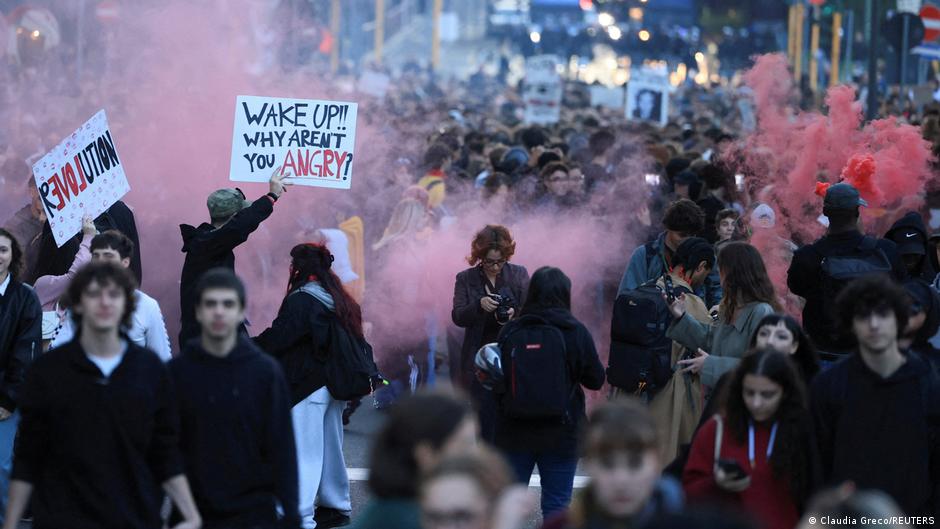
Italy faced another round of demonstrations on Saturday, October 24, as public anger over the high cost of living, fuel prices, military expansion and Prime Minister Giorgia Meloni’s government spilled into the streets of several major cities. The protests created a fresh test for businesses operating in urban centers, particularly luxury retailers, transport-linked companies and employers already navigating pressure on household purchasing power.
Police reported nine arrests and 371 preliminary detentions, including cases involving 110 minors, according to AFP. The security response followed demonstrations on October 17 and 18 that escalated into disorder, prompting the authorities to strengthen enforcement measures before the latest protests.
The mobilization highlighted a difficult operating environment for Italy’s corporate sector. Consumer-facing companies must contend not only with the economic grievances driving the demonstrations, but also with the possibility of disrupted transport, reduced foot traffic and damage to commercial property. For corporate leaders and boards, the immediate security concerns sit alongside a broader strategic question: how prolonged household dissatisfaction could affect demand, employee relations and confidence in major Italian cities.
Retailers fortify stores as Milan tightens security
Italian authorities deployed 500 members of elite military units to Milan after the earlier unrest. The government also simplified procedures for detaining minors and imposing financial penalties on their parents when property is damaged.
Drones and helicopters were used to monitor the demonstrations, while patrols at railway stations were reinforced. Authorities also closely tracked online activity in an effort to identify new calls for disorder. The scale of the preparations underscored the government’s determination to prevent a recurrence of the violence seen a week earlier.
In Milan, the protests remained largely peaceful until the evening, according to dpa. Demonstrators and law enforcement officers eventually clashed in the city center, where police stopped a column of protesters and used batons.
Fearing renewed disorder, owners of many luxury stores barricaded their display windows. The precaution carried particular significance in Milan, where premium retail is a visible part of the city’s commercial identity. Even without reported damage to those stores in the source account, defensive closures and fortified storefronts illustrate how civil unrest can impose costs through security spending, interrupted trading and reputational concerns around flagship shopping districts.
The business impact was most visible in Milan, where luxury retailers protected storefronts as police moved to contain demonstrators in the city center.
For executives responsible for physical retail networks, the demonstrations may reinforce the need for contingency plans covering employee safety, temporary closures and coordination with landlords and local authorities. Boards overseeing high-profile consumer brands may also scrutinize whether security arrangements are sufficient when stores become exposed to protests rooted in economic hardship.
Transport hubs become focal points
Police responses varied across cities but repeatedly centered on controlling access to strategically important urban areas. In Bologna, officers used tear gas and water cannons to prevent a column of demonstrators from approaching the railway station. In Turin, law enforcement personnel pushed protesters back with shields.
The focus on railway infrastructure points to the potential operational consequences of protests even when individual companies are not directly targeted. Restrictions near stations can affect passenger movement, staffing and deliveries, while uncertainty over access may deter customers from traveling into city centers. Companies dependent on predictable transport links could face short-term disruption if demonstrations continue or expand.
Rome saw a predominantly pro-Palestinian march through the historic center. At one point, participants entered the Colosseum, dpa reported. Protest actions also took place in Naples and Florence, showing that the movement extended beyond a single local flashpoint.
Economic grievances raise longer-term boardroom questions
The combination of complaints over living costs and fuel prices has direct relevance for corporate planning. Higher household expenses can weaken discretionary spending, while fuel-price pressure can affect commuting, logistics and operating budgets. The protests also linked those economic concerns with opposition to increased armament and criticism of Meloni’s policies, broadening the challenge facing the government.
Companies must now assess whether the demonstrations represent episodic disruption or a more persistent expression of consumer and worker strain. The answer could influence sales expectations, labor discussions and investment decisions, especially for businesses with large store portfolios or significant exposure to city-center traffic.
The government’s response also creates governance considerations. Expanded powers involving minors, penalties imposed on parents, digital monitoring and a visible military presence may reduce the immediate risk of disorder, but they also raise the political stakes surrounding future demonstrations. Businesses will need to avoid being drawn into that debate while maintaining clear policies on security, employee welfare and continuity of operations.
For Italy’s boards and executive teams, the weekend’s events provided a concrete reminder that cost-of-living pressures can move quickly from economic data into operational risk. The barricaded boutiques of Milan and the fortified railway approaches in Bologna showed how political dissatisfaction can reach commercial districts and infrastructure, even when protests remain mostly peaceful for much of the day.