Ukraine Says 28 Killed in Russian Barrage as Sanctions Debate Sharpens
Ukrainian officials said the combined missile and drone assault hit 13 regions, raising pressure on Western leaders over enforcement and escalation risks.
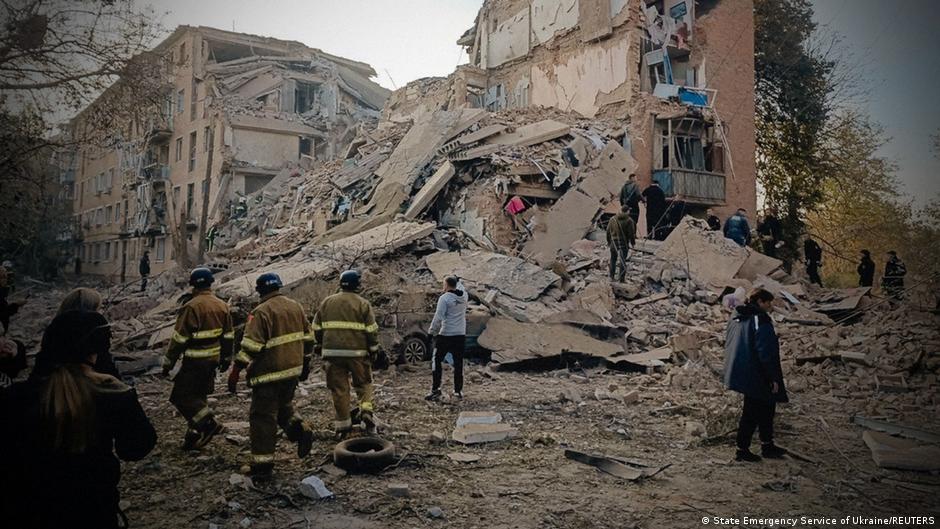
Ukraine’s government said 28 people were killed after a large-scale Russian attack using missiles and drones, a strike that immediately pushed the war back into the center of Western policy and business risk calculations.
Interior Minister Ivan Vyhovskyi said in a Telegram post on the evening of Wednesday, October 7, that 28 people had died in Ukraine as a result of the mass shelling by Russian forces. According to him, emergency service workers and police officers were able to pull people from under rubble, evacuate residents from damaged buildings and rescue others from fire. In total, he said, 29 people were recovered, evacuated or saved.
The most severe toll cited by officials was in Pryluky, in Ukraine’s Chernihiv region, where Vyhovskyi said 20 people were killed after a missile struck a residential apartment building. The dead included five children, three of whom were one year old. More than 14 hours after the strike, he said, crews were still clearing debris at the site.
President Volodymyr Zelensky said later that evening that 100 people were injured in the attacks. He described the assault as a combined strike involving many ballistic missiles, many cruise missiles and Shahed drones, followed during the day by additional attacks with Shahed drones and aerial bombs.
“The strike was combined: many ballistic missiles, many cruise missiles, Shaheds,” Zelensky said, according to his post.
Zelensky said Russian forces attacked 13 regions of Ukraine on October 7, using 70 missiles, including a significant ballistic component, along with Shahed drones. Vyacheslav Chaus, head of the Chernihiv regional military administration, had earlier reported more than 50 people injured as a result of the attack.
Sanctions Become a Boardroom Issue
For American executives, investors and boards with exposure to Europe, the attack adds a new layer to a conflict already embedded in energy markets, compliance systems, insurance costs and supply-chain planning. Zelensky used his public response not only to describe the human toll but also to argue that Western economic policy is shaping Moscow’s strategic calculations.
He said it was important that leaders not remain silent about what happened and about what he described as Russia’s intention to keep moving toward escalation, killings and shelling. In Zelensky’s view, the issue is not only battlefield deterrence but also whether President Vladimir Putin feels that continued attacks create meaningful problems for him.
Zelensky argued that the weakening of sanctions measures against Russia and signals about removing sanctions from oligarchs send Moscow what he called signals of normalization of the war against Ukraine. He said Putin can still sell oil and that, when he counts profits in dollars and euros, the war still pays and remains profitable for him to wage.
That statement lands directly in the domain of corporate decision-making. Western companies have spent more than two years navigating sanctions restrictions, divestment pressure, disrupted trade routes and heightened scrutiny over dealings that could indirectly touch Russian revenues. Zelensky’s argument implies that any easing, exemption or enforcement gap is not merely a diplomatic choice but a market signal that may affect the Kremlin’s cost-benefit analysis.
The same logic applies to banks, insurers, commodities traders and industrial firms. Oil revenues remain central to the economic dimension of the war, and any perceived loosening of restrictions can alter compliance assumptions across sectors. For boards, the practical question is not only whether transactions are technically permissible, but whether they carry strategic, reputational or secondary-risk exposure if Western policy hardens again after attacks on civilians.
Escalation Risk for Europe and Western Markets
Zelensky framed the attack as a problem not only for Ukraine and its people, but for all of Europe and the Western world. That formulation is aimed at governments, but it also resonates with multinational companies whose operations depend on stable European energy flows, predictable sanctions regimes and confidence that the war will not spill into wider regional disruption.
The October 7 barrage, as described by Ukrainian officials, combined several categories of threat: ballistic missiles, cruise missiles, Shahed drones and aerial bombs. For civilian infrastructure and urban centers, that mix complicates air defense and emergency response. For Western policymakers and corporate planners, it points to a conflict environment in which Russia can sustain repeated large-scale attacks across multiple Ukrainian regions.
The continuing debris-clearing operation in Pryluky also underscores the human and operational cost of residential strikes. Emergency workers and police were still working more than 14 hours after the apartment building was hit, while officials updated casualty counts and injury figures. Such incidents have repeatedly intensified calls for air-defense support, tighter sanctions enforcement and continued Western financial backing.
For U.S. business leaders, the immediate commercial implications may appear indirect, but the broader consequences are not. War-related volatility can affect energy prices, defense spending priorities, reconstruction planning, agricultural flows, logistics routes and the regulatory environment governing cross-border transactions. The sharper the escalation, the harder it becomes for companies to treat Ukraine-related risk as a contained regional issue.
The latest Ukrainian statements also raise the stakes for any Western discussion of sanctions relief. Zelensky’s message was that economic pressure, or the lack of it, is read in Moscow as a strategic signal. Whether governments accept that framing will matter for corporate compliance departments, investors assessing European exposure and boards weighing the long-term costs of operating around a war that Ukrainian officials say is being normalized through weakened pressure.
In that sense, the attack described by Ukrainian officials is both a military and political event. It killed civilians, including children, injured scores of people and damaged residential buildings. It also intensified Ukraine’s appeal to Western leaders to connect battlefield violence with financial policy, sanctions enforcement and the economic incentives that Kyiv says continue to sustain Russia’s war effort.