Armenian Parliamentary Elections Signal Continuity Under Prime Minister Pashinyan Amid Geopolitical Tensions
Preliminary results show Prime Minister Pashinyan’s Civil Contract party leading, shaping Armenia’s strategic alignment between the EU and Russia.
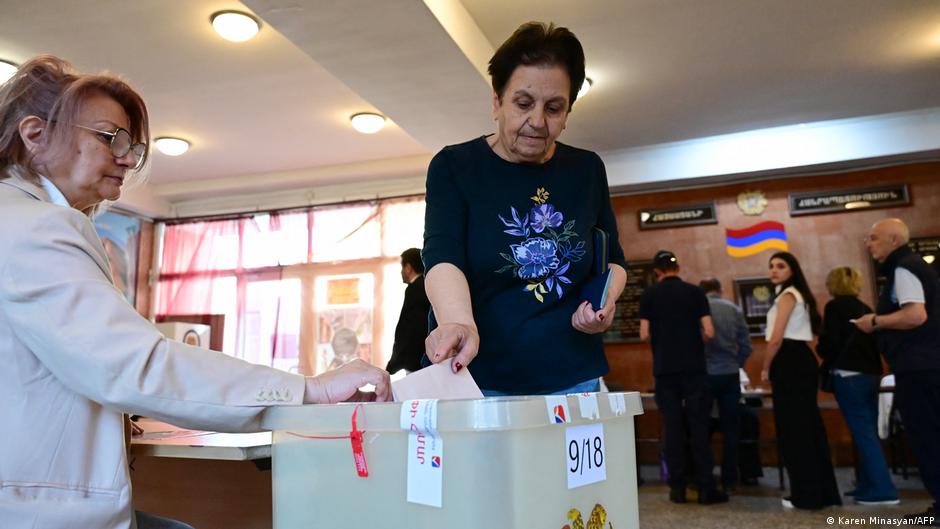
Armenia held decisive parliamentary elections on June 7, pivotal in determining the country’s foreign policy trajectory amid a complex geopolitical landscape. Preliminary results from the Central Electoral Commission reveal that Prime Minister Nikol Pashinyan’s Civil Contract party is leading with 50.86% of the vote after counting approximately 56% of ballots.
The opposition alliance Strong Armenia, led by Russian-Armenian businessman Samvel Karapetyan, secured 23.19%, while another opposition bloc, Armenia, headed by former President Robert Kocharyan, gained 9.6%. Other parliamentary entrants include the Prosperous Armenia party, led by businessman Gagik Tsarukyan, with 4.1%, and the Wings of Unity party of former ombudsman Arman Tatoyan, at 2.3%.
Voter turnout reached 58.97%, surpassing participation levels in the 2018 and 2021 elections. Armenia’s National Assembly consists of 105 deputies, with four mandates reserved for national minorities including Yazidis, Russians, Kurds, and Assyrians.
Implications for Governance and Foreign Policy
“The Civil Contract party will unilaterally form the government,” Prime Minister Pashinyan declared shortly after preliminary results, signaling a clear path toward consolidating executive power.
This statement triggered criticism from opposition parties, with the Armenia bloc accusing Pashinyan of steps towards power usurpation and undue interference in the Central Electoral Commission’s functions. Arman Tatoyan of Wings of Unity labeled the remarks unconstitutional, exceeding the prime minister’s authority.
Armenia’s electoral system uses proportional representation with a 4% threshold for parties and higher thresholds for political blocks. With nearly 2.5 million eligible voters and no overseas polling stations, electronic voting was arranged for diplomats abroad. The electoral code mandates the formation of a stable parliamentary majority at 54%. Should no majority emerge, a runoff election will be held.
Strategically, Pashinyan’s 2025 legislative direction prioritizes closer integration with the European Union, placing Armenia on a collision course with Moscow. Despite this, the prime minister insists he does not seek to sever ties with Russia. Conversely, the opposition favors sustaining strong relations with Russia.
Russia has expressed discontent with Pashinyan’s pro-EU positioning. Ahead of elections, Moscow imposed bans and restrictions on Armenian exports including alcohol, agricultural products, flowers, and fish. Russian President Vladimir Putin has likened the political developments in Armenia to precursors of the Ukraine crisis, signaling heightened tensions and potential economic leverage in response to Yerevan’s geopolitical realignment.
The election outcome is thus critical not only for domestic governance but also for the executive’s mandate in navigating Armenia’s delicate balance between Western integration and maintaining traditional ties with Russia. Corporate and investment stakeholders within and outside Armenia will closely observe how the new government manages these competing pressures, affecting regional stability, trade relations, and economic policy direction.