Dodik Allies Hold Power in Bosnia Vote, Extending Serb Republic Strategy
Preliminary results show ruling-party candidates prevailing across Bosnia and Herzegovina, reinforcing Milorad Dodik’s political network despite his ban.
Ruling-party candidates and political allies of Milorad Dodik emerged as the clear winners in Bosnia and Herzegovina’s latest elections, according to preliminary results published by the Central Election Commission on the evening of Sunday, October 4. For U.S. business readers watching political risk in southeastern Europe, the result points less to abrupt change than to continuity: entrenched regional leadership, a complex governing structure, and a continued role for Dodik’s network even after his forced removal from office.
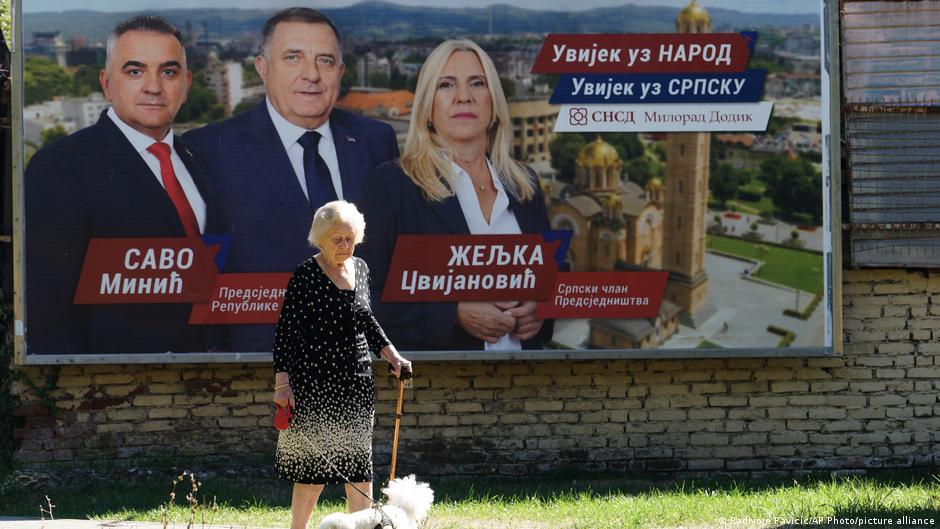
The most closely watched contest was in Republika Srpska, the predominantly Serb entity within Bosnia and Herzegovina. Savo Minic, the prime minister of Republika Srpska, won the race for president of the region. He was backed by Dodik, the former president of Republika Srpska, who is known for his closeness to Russia. Another Dodik associate, Zeljka Cvijanovic, also secured a place in Bosnia and Herzegovina’s state presidency, according to preliminary results.
The elections covered members of the state presidency, the central parliament, two regional parliaments, and the presidency of Republika Srpska. They produced no major surprises. Preliminary voting data showed candidates from ruling parties prevailing across the main races, preserving the political balance that companies, investors, and foreign governments have had to navigate in Bosnia and Herzegovina for years.
Continuity Across a Fragmented Political System
After 95% of ballots had been counted, Denis Becirovic remained the leading candidate for the Bosniak member of the country’s presidency. Becirovic, who previously served as chairman of the presidency, received about 38% of the vote. Darijana Filipovic was preliminarily set to represent Croats in the presidency, with about 48% of the vote. Serb voters favored Zeljka Cvijanovic, who received about 55% and had also previously served in the presidency.
Bosnia and Herzegovina has a distinctive presidential structure in which the role of head of state is shared by representatives of Croats, Bosnian Muslims, and Serbs, who occupy three seats in the presidency. The system was created under the 1995 Dayton Accords, which were negotiated to settle disputes among Bosnian Muslims, Orthodox Serbs, and Catholic Croats and to end the civil war. Many analysts regard the resulting arrangement as inefficient.
For companies assessing Bosnia and Herzegovina, the election reinforces an operating environment shaped by layered institutions, entity-level power centers, and leaders whose influence can extend beyond formal office.
That institutional design matters for business because authority is dispersed across national and regional structures. Corporate strategy in such an environment depends not only on national policy but also on the positions of entity governments and party networks. The preliminary results suggest that ruling parties retain the ability to shape that environment, particularly in Republika Srpska, where Dodik’s political organization remains influential.
Republika Srpska Race Anchors the Political Signal
The central uncertainty in the vote was the race for president of Republika Srpska. The contest brought together opposition candidate Branko Blanusa and Savo Minic, the sitting regional prime minister. Preliminary results showed Minic winning. In most electoral districts in Republika Srpska, he was ahead of Blanusa. The opposition candidate won some districts, but based on Central Election Commission data, those results did not alter the overall outcome.
Minic, like Cvijanovic, ran on the ticket of the Alliance of Independent Social Democrats, known by its Russian abbreviation SNSD. The party was founded by Dodik, who previously served as president of Republika Srpska. In 2025, Dodik was forcibly removed from office for failing to comply with rulings of Bosnia and Herzegovina’s Constitutional Court and international agreements.
According to the Central Election Commission, SNSD is also winning the election for the parliament of Republika Srpska, the National Assembly. A majority of Bosnian Serbs also voted for the same party in elections to the lower chamber of the national parliament, the House of Representatives of the Parliamentary Assembly.
For boardrooms, that combination of wins is significant. It suggests that SNSD’s position is not confined to a single executive office. The party appears to retain strength across the regional presidency, the regional legislature, and representation in the national parliamentary structure. That kind of multi-level presence can give a political organization leverage over policy implementation, institutional negotiations, and disputes between state and entity authorities.
Dodik’s Role Remains Central Despite Court Ban
Dodik has already congratulated both Minic and Cvijanovic on their victories. Under a court decision, Dodik himself is barred from political activity for six years. He has refused to recognize the court’s decision and traveled to Moscow seeking support. Dodik and Minic met with Vladimir Putin in the Kremlin on September 29.
The outcome therefore highlights a boardroom-relevant distinction between formal office and political influence. Dodik may be legally barred from political activity, but the candidates associated with him and his party have prevailed in key contests. That raises practical questions for outside companies and policymakers about whom they must understand when assessing decision-making in Republika Srpska and Bosnia and Herzegovina more broadly.
The Russian dimension also remains part of the risk picture. The source article describes Dodik as close to Russia and notes his trip to Moscow for support, as well as his Kremlin meeting with Putin alongside Minic days before the vote. For American business leaders, that does not by itself translate into a new policy shift, but it does reinforce the need to view Bosnia and Herzegovina through the lens of geopolitical alignment, sanctions exposure, and regional stability.
At the same time, the election results should not be read as a clean break from the past. The preliminary data instead point to a reaffirmation of existing power structures. The presidency’s three-member model remains intact. The entity-level contest in Republika Srpska favored a candidate backed by Dodik. SNSD is positioned strongly in both regional and national parliamentary races. And a Dodik ally is set to continue representing Serbs in the state presidency.
For companies operating in or around the region, the implication is straightforward: political continuity may reduce the immediate surprise factor, but it does not necessarily reduce complexity. Bosnia and Herzegovina’s post-Dayton governance system remains cumbersome, and analysts have long considered it inefficient. The latest election appears to preserve that system’s familiar tensions, with ruling parties maintaining control and Dodik’s circle retaining a central role in Republika Srpska’s political direction.