Russian Strikes Hit Ukraine Infrastructure and German-Owned Auto Supplier
Attacks across several Ukrainian regions killed two people, disrupted electricity supplies and halted production at a German-owned factory.
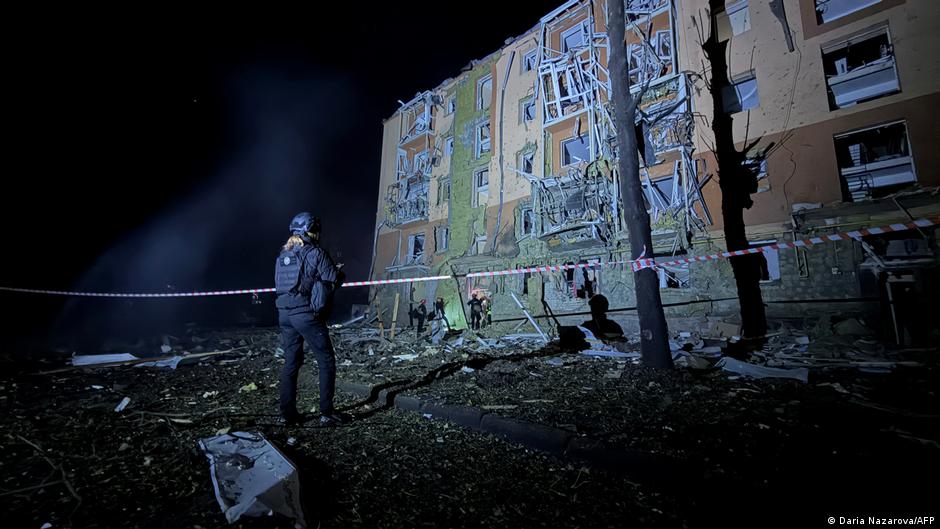
Russian drone and missile strikes across several Ukrainian regions late Saturday, Oct. 17, and overnight into Sunday killed two people, injured others and damaged critical infrastructure, according to local authorities. The attacks also forced a German-owned automotive supplier to suspend operations, underscoring the continuing risks facing international manufacturers and infrastructure operators in Ukraine.
One person was killed and four others were injured during an evening drone attack on Poltava, regional military administration chief Vitaliy Diakivnych wrote on Telegram. Four private homes were damaged in the city, while another five were damaged in the Tereshky rural community.
In Zaporizhzhia, a drone struck a multistory residential building overnight, regional military administration chief Mykhailo Semikin said. A 27-year-old woman was killed, and another woman was injured.
Three people were injured when Russian forces used ballistic weapons against two districts of Kharkiv on Saturday evening, Mayor Ihor Terekhov said. According to the head of the Kharkiv regional military administration, men aged 66 and 42 were wounded in the Slobidskyi district and hospitalized. A 26-year-old woman was injured in the city’s Osnovianskyi district.
Energy disruption raises operational risks
The attacks also affected essential infrastructure and power supplies in several regions, adding to the operating uncertainty confronting Ukrainian companies, public utilities and international businesses with local facilities or suppliers.
In the Vinnytsia region, an attack caused damage to critical infrastructure and triggered emergency electricity outages, regional military administration chief Nataliia Zabolotna said on Telegram. She warned that the electricity supply would remain unstable in the near term.
“In the near future, the situation with the electricity supply will remain unstable,” Zabolotna said.
In the Chernihiv district of the region bearing the same name, 19,000 customers were left without electricity following evening strikes, representatives of the regional energy operator Chernihivoblenergo said. Critical infrastructure was also attacked in Dnipro, according to regional military administration chief Oleksandr Hanzha.
For corporate leaders, repeated damage to the power network creates consequences beyond immediate outages. Manufacturers must assess whether backup generation is sufficient to protect production lines, data systems and employee safety. Logistics executives face the possibility of disrupted warehousing and transportation, while boards overseeing Ukrainian operations must continually review business-continuity plans, insurance coverage and capital allocation under wartime conditions.
German-owned automotive plant suspends work
The clearest direct corporate impact was reported in Lutsk, where a plant operated by German company Kromberg & Schubert suspended work after a strike. The company manufactures electrical wiring systems for vehicles, placing the facility within an automotive supply chain in which production interruptions can affect customers beyond the immediate region.
Russia’s Defense Ministry said the plant had been targeted because it was used for the “repair of automotive equipment in the interests of the Armed Forces of Ukraine.” The source report provided no further details about the duration of the shutdown, the scale of damage at the facility or the effect on employees and customers.
The suspension presents executives with decisions common to companies operating near active conflict zones but unusually difficult in their consequences. Management may need to determine when the site can safely reopen, whether production can be shifted elsewhere and how to communicate potential delays to automaker customers. Directors must also weigh employee security against contractual obligations and the strategic importance of maintaining a presence in Ukraine.
The incident illustrates how distinctions between civilian industrial production and assets Russia claims support Ukraine’s military can expose foreign-owned businesses to direct physical risk. That uncertainty can complicate investment decisions, supplier contracts and compliance reviews for multinational companies, particularly when a factory’s commercial capabilities could also be relevant to military logistics.
Across the affected regions, the immediate human toll remained the most severe consequence: two people were killed in Poltava and Zaporizhzhia, while residents were injured in Poltava, Zaporizhzhia and Kharkiv. At the same time, damage to homes, electricity systems and industrial facilities showed how a single night of attacks can create overlapping humanitarian, operational and board-level challenges for organizations working in Ukraine.