Russian Strikes on Kyiv Hit Maternity Hospital Area, Killing Two
Kyiv’s mayor said missile debris damaged medical property and residential areas, underscoring the operational risks facing Ukraine’s capital.
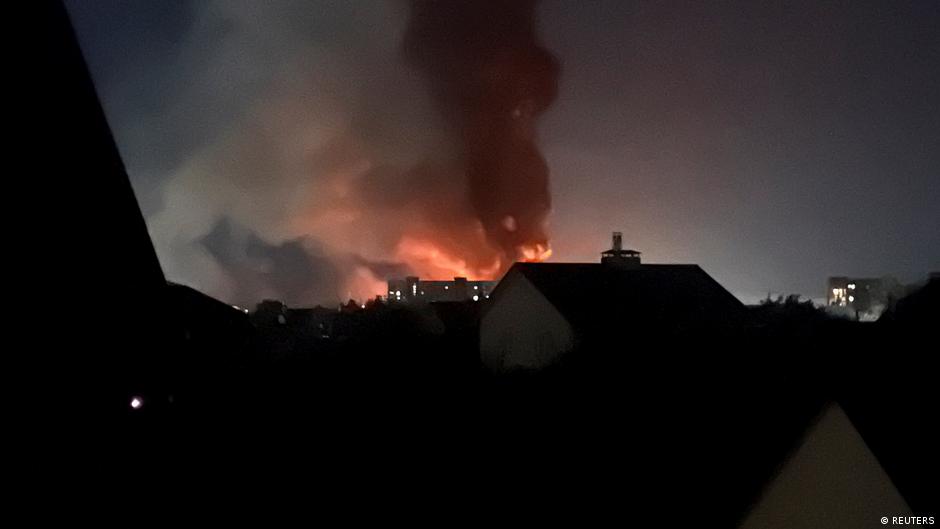
Two people were killed and six others were injured after Russian armed forces struck Kyiv overnight into Thursday, September 24, according to Vitali Klitschko, the mayor of Ukraine’s capital. The attack damaged residential areas, administrative property and medical infrastructure, including the area around a maternity hospital, adding to the strain on city services and emergency response systems.
Klitschko said on Telegram that two of the injured were in serious condition. The damage was spread across several districts, suggesting a broad and complex incident for municipal responders, utility managers and health-care administrators already operating under wartime pressure.
In Kyiv’s Podilskyi district, missile debris struck a parking lot near a maternity hospital, setting vehicles on fire. Windows and part of the building’s facade were damaged, Klitschko said. Preliminary information indicated there were no casualties inside the medical facility. A nearby clinical and diagnostic center was also damaged, he added.
The mayor also reported that in the Darnytskyi district, a missile fragment fell onto a roadway. In the Solomianskyi and Podilskyi districts, debris landed on the grounds of nonresidential development. In the Dniprovskyi district, fragments fell in the courtyard of a 16-story residential building and private homes, as well as on an administrative building. Private estates were affected, and one house sustained destruction.
Critical Infrastructure in the Line of Fire
The Ukrainian Telegram channel Insider UA reported that about 20 missiles of various types were fired at Kyiv over a 35-minute period and said the main target of the attack was the electric power sector. That claim, if confirmed by officials, would point to a familiar pattern in Russia’s campaign: pressure on the systems that keep a major urban economy functioning, from electricity and transport to hospitals and housing.
For city leaders and corporate operators in Kyiv, such strikes are not only a humanitarian emergency but also a test of continuity planning. Medical facilities must preserve patient care while assessing damage to buildings, windows, heating, backup power and access routes. Businesses face disruptions in commuting, logistics and staffing. Property managers and municipal agencies must inspect damaged residential and administrative sites while emergency teams work across multiple districts.
The reported strike near a maternity hospital is especially significant for public-sector risk management. Even when no patients or medical workers are injured inside a facility, damaged facades, broken windows, fire in adjacent parking areas and harm to nearby diagnostic centers can interrupt clinical workflows. Hospitals depend on tightly coordinated systems: ambulances, entrances, sterile areas, power supply, communications and staff availability. Damage around the perimeter can still create operational hazards.
“All relevant services are on site. Operational headquarters are being deployed to provide assistance to people,” Serhiy Lysak wrote, referring to the response in Odesa.
That line, from the head of the Odesa city military administration, reflects the same management reality confronting Kyiv: the rapid conversion of emergency response into an organized service operation for civilians. In wartime cities, crisis management is not episodic. It is an operating model.
Boardroom Implications for a Capital Under Attack
The strikes also carry implications for companies, investors and institutions with exposure to Ukraine. Kyiv remains the political, administrative and commercial center of the country. Attacks that affect roads, residential areas, administrative buildings and medical facilities can alter the daily calculations of employers and service providers, even when the immediate physical damage is localized.
Boards and executive teams operating in or around Ukraine must weigh more than direct facility risk. Workforce safety, insurance coverage, supply chain alternatives, data resilience, employee relocation policies and business interruption planning all become board-level questions when a capital city faces repeated missile attacks. The reported focus on energy infrastructure is particularly relevant because power reliability affects nearly every sector, including banking, telecommunications, health care, manufacturing support, retail and digital services.
The attack’s timing and reported scale also matter. Insider UA’s account that about 20 missiles were launched at Kyiv within 35 minutes describes an intense window of pressure on air defenses, emergency services and public communication channels. For managers, such compressed events create cascading demands: confirming employee status, checking sites, updating customers, coordinating with authorities and deciding whether operations can continue.
Klitschko’s description of debris across Darnytskyi, Solomianskyi, Podilskyi and Dniprovskyi districts indicates that the city’s exposure is distributed rather than confined to a single neighborhood. That complicates response planning. A company may have offices in one district, employees living in another, logistics routes passing through a third and service providers based in a fourth. A missile attack that scatters debris across the urban map can disrupt all of those points at once.
Meanwhile, the reported strike on Odesa widened the picture beyond Kyiv. Serhiy Lysak, head of the Odesa city military administration, said on Telegram that Russian forces attacked Odesa, damaging medical and educational institutions as well as residential buildings. He said relevant services were at the scene and operational headquarters were being established to help residents.
For Ukraine’s urban administrations, the events in Kyiv and Odesa illustrate the dual burden of wartime governance: immediate rescue and repair, followed by the longer work of restoring confidence in civic and commercial systems. For businesses, they reinforce a hard strategic truth. In Ukraine’s major cities, security risk is not separate from corporate planning. It is embedded in decisions about offices, people, energy, capital spending and continuity of service.