Yabloko Secures Novgorod Seat, Preserving Key Ballot Access Path
The party’s 6.2 percent showing in Novgorod carries strategic value after setbacks that narrowed its national electoral options.
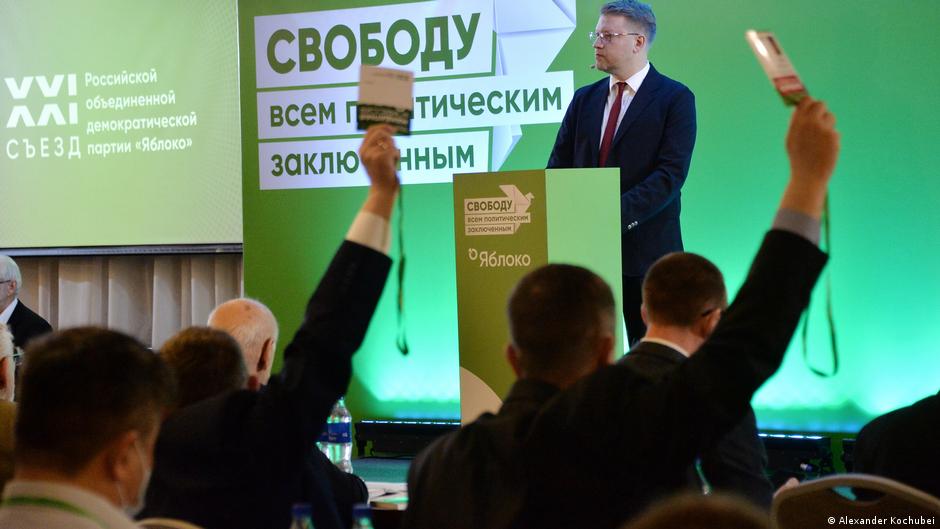
Russia’s liberal Yabloko party is set to enter the Novgorod Regional Duma, a result that carries significance well beyond a single regional legislature. According to the Russian Central Election Commission, Yabloko had 6.2 percent of the vote after 96.86 percent of precinct protocols were counted, clearing the 5 percent threshold required to win representation in the regional parliament.
For a party operating under severe political constraints, the Novgorod outcome functions less like a routine electoral gain than a strategic preservation of operating capacity. A seat in a regional parliament allows Yabloko to continue taking part in State Duma elections without collecting voter signatures, an administrative requirement that can be costly, time-consuming and politically vulnerable for opposition parties.
The result also marks a sharp improvement from the previous election at the same level in 2021, when Yabloko received 3.83 percent of the vote. In the current contest for the eighth convocation of the Novgorod Regional Duma, the party’s preliminary 6.2 percent share was enough to move it over the formal barrier and into the legislature.
A Small Vote Share With Large Strategic Implications
In business terms, Yabloko’s Novgorod result resembles the retention of a critical license rather than the capture of a dominant market position. The party remains far behind the larger pro-government and parliamentary parties in vote share. United Russia, according to the same data, had 38.37 percent in the Novgorod vote. The Communist Party was at 14.54 percent, the Liberal Democratic Party at 12.01 percent, New People at 9.87 percent, A Just Russia at 7.7 percent and the Party of Pensioners at 5.55 percent.
Yet the practical value of representation is substantial. Yabloko’s ability to nominate candidates in future State Duma elections without gathering signatures gives the party a route to stay formally active at the federal level. That route has become more important after the party’s existing regional bases were disrupted.
“For the party, it has a very practical meaning: having a deputy in a regional parliament will allow Yabloko to continue taking part in State Duma elections without collecting signatures,” a source in Yabloko said.
The source, speaking anonymously, said the party was “very pleased” with the preliminary result in Novgorod. Before these elections, Yabloko had three factions, in Pskov, St. Petersburg and Karelia, but its lists there were removed, the source said. Against that backdrop, Novgorod becomes a governance and ballot-access foothold at a time when the party’s broader electoral infrastructure has been under pressure.
A Campaign Under Administrative Pressure
The campaign in Novgorod took place under difficult conditions, according to the Yabloko source. The entire party list on the ballot was marked with a label referring to a “foreign agent” because the list leader, party deputy chair Anna Cherepanova, had been recognized as affiliated with a “foreign agent.” Cherepanova herself was removed from the election over an administrative case under Article 20.3 of the Russian Code of Administrative Offenses.
The source said neither the ballot label nor the removal of the list leader prevented the party from posting a strong result. For Yabloko’s leadership and advisers, that outcome may influence future decisions about where limited organizational resources are deployed. The Novgorod vote suggests that even under reputational and procedural burdens imposed during the campaign, the party can still mobilize enough support to cross a decisive threshold in at least some regional environments.
For political organizations, as for companies, constraints shape strategy. The removal of candidates, the labeling of ballot materials and the loss of regional lists all raise the operational cost of contesting elections. Yabloko’s Novgorod performance therefore gives the party not only a legislative seat but also evidence for internal planning: the brand retains measurable electoral demand, even after institutional shocks.
Federal Context and Opposition Positioning
The Novgorod result follows a major federal setback. On August 10, Russia’s Supreme Court removed Yabloko’s federal list from State Duma elections in response to a lawsuit by Rodina. Rodina accused the party, among other things, of copyright violations and illegal payments for election campaigning. Despite that decision, Yabloko candidates are still taking part in the vote in single-mandate districts.
Yabloko’s political positioning also distinguishes it from other Russian parties. It has been the only Russian party to oppose the war in Ukraine. That stance has made the party’s continued participation in elections a matter of international attention as well as domestic political calculation.
Jürgen Hardt, the foreign policy spokesman for the CDU/CSU parliamentary group in the Bundestag, previously told DW that by sidelining Yabloko, Russian President Vladimir Putin had “excluded from the electoral process the last significant voice of opposition.” The Novgorod result does not reverse the broader pressures on the party, but it complicates the picture by showing that the organization can still secure institutional representation in a regional legislature.
For Yabloko’s decision-makers, the boardroom question now is how to convert a narrow regional victory into durable national capacity. The party’s immediate gain is technical but important: representation in Novgorod can preserve access to future federal races without the signature hurdle. Its broader challenge is strategic: maintaining relevance, personnel and voter trust while operating inside a system that has repeatedly narrowed its space to compete.
For Russia’s electoral landscape, the outcome is a reminder that even modest vote shares can carry outsized consequences when procedural rules determine who is allowed to appear on the ballot. Yabloko’s 6.2 percent in Novgorod is not a broad national breakthrough. But for a party that has lost federal list access and seen regional lists removed elsewhere, it is a material asset with implications for future elections.