Georgia Opposition Launches New Protest Wave as Political Risks Mount
A court case targeting opposition parties raises governance and strategic risks as Georgia’s political confrontation deepens.
Georgia’s opposition leaders have declared the start of a new wave of protests against the governing Georgian Dream party, escalating a political confrontation with significant implications for the country’s institutions, investment environment and European ambitions.
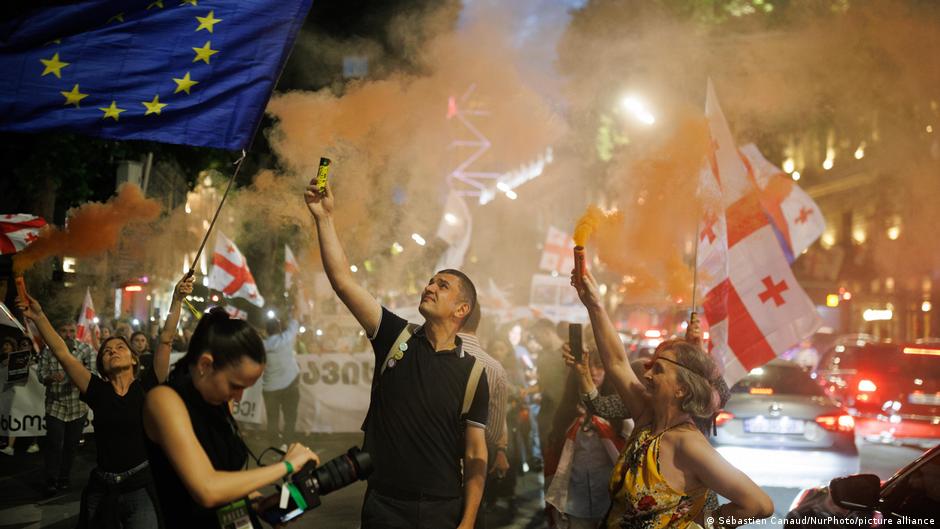
Thousands of people joined a protest march in Tbilisi on Sunday, October 25, according to Kavkazsky Uzel. The demonstration, organized by opposition and civil society representatives under the slogan “Georgia Without Ivanishvili,” took place as Georgia’s Constitutional Court considers a lawsuit seeking to ban opposition parties.
Participants marched from Tbilisi State University toward Rustaveli Avenue, carrying the flags of Georgia, Ukraine and the European Union. A large contingent of security personnel was also present, the report said.
The lawsuit and the accompanying street mobilization increase uncertainty for companies and investors assessing Georgia’s political stability. A prohibition on opposition parties could narrow the country’s formal political arena, intensify public resistance and further complicate relations with European institutions. For corporate leaders, the immediate issues include the risk of operational disruption during large demonstrations and the longer-term reliability of Georgia’s governance framework.
Opposition Sets November 28 as a Critical Date
Nika Gvaramia, leader of the Coalition for Change, described Sunday’s march before it began as the opening of a new protest wave. He said the movement would need to build toward a culmination, potentially on November 28—the second anniversary of the beginning of mass protests in Georgia—or in the days that follow.
“We are starting today, and we definitely need a culmination, whether it is November 28 or in the following days. It is important that there are very many of us on the 28th, so that the wind cannot extinguish the fire.”
Opposition organizers are planning a large demonstration for November 28. The date could serve as a test of the movement’s ability to sustain public participation and of the government’s approach to managing dissent. Previous protests have involved clashes with police and the use of tear gas and water cannons to disperse demonstrators.
Gigi Tsereteli, leader of European Georgia, also attended Sunday’s march and characterized the current situation as an extraordinary reversal for a country once considered a leader in the European integration process.
“A large and important rally is planned for November 28. What is happening in Georgia today in terms of the destruction of democracy and disruption is truly unimaginable against the backdrop of the fact that we were a champion country on the path toward European integration, while today we are outsiders,” Georgia Online quoted him as saying.
Tsereteli added that parties were being banned and political life was effectively being restricted. He also pointed to political prisoners as another important challenge.
Governance Questions Carry Economic Consequences
The confrontation places renewed focus on Bidzina Ivanishvili, the influential figure associated with Georgian Dream and the person explicitly targeted by the march’s slogan. From a boardroom perspective, the central question is whether political decision-making will produce a more predictable operating environment or deepen institutional strain.
Georgia’s location and its long-standing European orientation have supported its strategic relevance. However, a prolonged conflict involving the government, opposition groups, civil society and the courts can affect perceptions of political and regulatory risk. Executives considering capital commitments typically look beyond near-term growth prospects to the durability of institutions, the handling of public dissent and the direction of international alignment.
The latest march follows a protest cycle that began in spring 2024 over the law on “foreign agents.” The demonstrations intensified after Georgian Dream won the parliamentary election. In November of that year, the dispute developed into a broader crisis after the authorities decided to postpone negotiations on Georgia’s accession to the European Union until 2028.
That decision introduced a longer strategic horizon to the conflict. The issue is no longer confined to a single law or election result; it concerns the country’s political trajectory and the conditions under which businesses will make long-term decisions. Delayed EU accession talks may also influence expectations surrounding regulatory convergence and Georgia’s integration with European markets.
The Constitutional Court’s handling of the lawsuit against opposition parties now represents another consequential institutional decision. Its outcome could reshape political competition and affect how domestic and international stakeholders assess checks and balances in Georgia.
Attention will next turn to November 28, when opposition leaders expect a significantly larger turnout. The scale of that demonstration, the authorities’ response and any developments in the court case will help determine whether the new protest wave remains a recurring challenge or develops into a more acute political crisis.