German Anti-Extremism Protests Signal Rising Political Risk for Business
Demonstrations across more than 35 German cities followed AfD’s regional election win and sharpened debate over how institutions should respond.
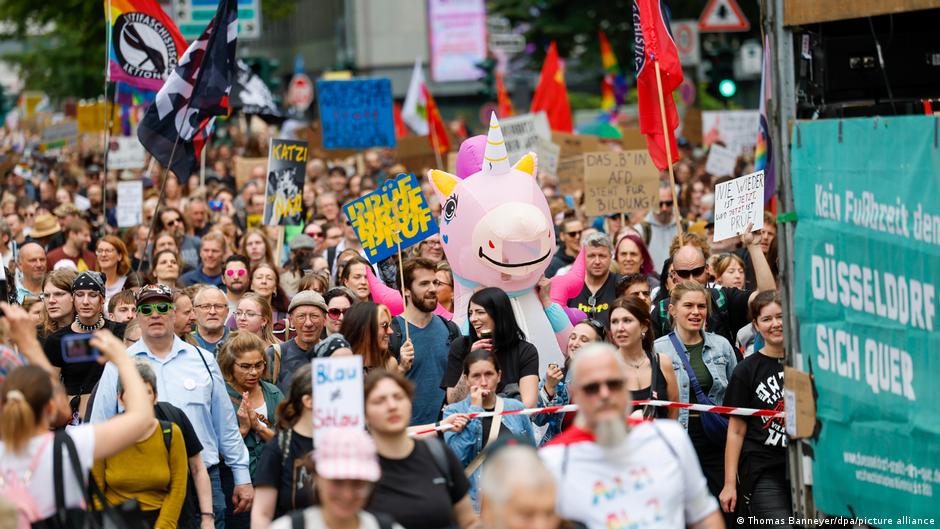
Mass demonstrations against right-wing extremism took place in more than 35 German cities on Saturday, September 12, putting fresh public pressure on political institutions and sending a broader signal to companies and investors watching Europe’s largest economy for signs of social and policy volatility.
The protests came one week after the far-right Alternative for Germany, or AfD, won state elections in Saxony-Anhalt. More than 100 associations were involved in organizing the demonstrations, which drew tens of thousands of people nationwide and underscored how quickly a regional political result can become a national reputational and governance issue.
Turnout was particularly high in several major commercial and administrative centers. In Hamburg, organizers estimated that 25,000 people joined the demonstration. In Düsseldorf, organizers put attendance at about 20,000, a figure also confirmed by local police. In Berlin, law enforcement estimated that 18,000 people took part. Public broadcaster ARD estimated participation in Munich at 12,000, while about 2,000 people demonstrated in Mainz.
Smaller rallies were also held in several state capitals and regional centers. Around 1,100 people joined a demonstration in Magdeburg, the capital of Saxony-Anhalt. Saarbrücken drew 1,500 participants, Erfurt saw several hundred, and Schwerin, the capital of Mecklenburg-Western Pomerania, saw several dozen. The Schwerin demonstration took place one week before local elections in a state where polls also show AfD in the lead.
Boardroom Relevance Beyond the Street Protests
For corporate leaders, the demonstrations are not merely another chapter in German party politics. They point to a more complex operating environment in which questions of institutional trust, workforce expectations, public procurement, regional investment, and brand positioning are increasingly tied to the country’s political trajectory.
Germany remains a key market for multinationals and a major base for industrial production, logistics, financial services, technology, and export-oriented manufacturing. When large demonstrations unfold simultaneously across dozens of cities, executives are likely to read them as a measure of public sensitivity around democratic norms and political boundaries, especially in regions where election results or polling indicate growing support for AfD.
The pressure is particularly relevant for companies with large German workforces, works councils, public-sector contracts, or prominent consumer brands. Employers have to balance political neutrality with compliance obligations, diversity commitments, employee expectations, and reputational risk. The latest protests suggest that silence or ambiguity around right-wing extremism can become difficult to sustain when civic groups are mobilizing at scale.
“Prüfung Rettet Übrigens Freiheit” — the phrase promoted by the Prüf campaign, meaning “review, incidentally, saves freedom.”
In several cities, including Munich, Mainz, Saarbrücken and Magdeburg, demonstrations were held as part of the Prüf campaign. The campaign calls for a thorough review of parties classified by Germany’s Federal Office for the Protection of the Constitution, known as BfV, as either suspected of right-wing extremism or definitively right-wing extremist. The campaign name translates from German as “check” or “review,” and organizers present it as an acronym for Prüfung Rettet Übrigens Freiheit.
That framing matters because it moves the debate from street protest into institutional process. Demonstrators called for the launch of proceedings to ban AfD after the BfV classified the party in May 2025 as right-wing extremist at the federal level. That classification, however, is not currently in effect because of a lawsuit filed by the party.
The demand for a ban procedure raises serious implications for Germany’s political system. For business leaders, it also highlights uncertainty over how federal institutions, courts, state governments, and voters may shape the rules of engagement with a party that is gaining electoral strength while facing scrutiny from domestic security authorities.
Firewall Debate Adds Strategic Uncertainty
The protests also coincided with fresh polling that shows German public opinion divided on how to handle AfD. An INSA poll conducted on September 10 and 11 found that 42% of respondents support the idea of banning AfD, while 45% oppose it. The same poll found that 46% of Germans oppose the “firewall” policy toward AfD, under which other parties refuse cooperation with it. Thirty-four percent support maintaining that barrier, while 20% were undecided.
Those numbers point to a polarized political market, not a settled consensus. In boardrooms, that kind of division can complicate assumptions about future coalition politics, regulatory priorities, regional economic policy and the reputational consequences of engagement with political actors. The firewall debate is especially significant because it affects whether AfD remains isolated or becomes a potential participant in formal or informal governing arrangements.
The slogans at the demonstrations reflected the urgency felt by organizers and participants. In Düsseldorf, protesters rallied under the message “No step back! Against AfD and right-wing agitation.” In Hamburg, the slogan was “Time to act — freedom must be defended.” The language was political, but its implications extend into the civic environment in which companies operate.
Companies doing business in Germany now face a familiar but intensifying challenge: how to plan for markets where democratic institutions are stable but political fragmentation is rising. The demonstrations show that civil society remains highly mobilized against right-wing extremism. At the same time, AfD’s electoral gains and polling strength show that the party’s influence remains a significant factor in regional and national politics.
For executives, the lesson is not that a single protest weekend changes Germany’s investment fundamentals. Rather, it is that political risk in the country increasingly includes questions of social cohesion, institutional response and public expectations of corporate responsibility. In that environment, German political developments are no longer background noise for business strategy. They are becoming a governance issue that boards, risk committees and senior management teams may need to track with the same discipline they apply to regulation, labor markets and supply chains.