Macron Sees Russian Mobilization as Credible, Raising Risks for Europe
The French president said Moscow could call up about 300,000 people while treating Europe as Ukraine’s strategic rear.
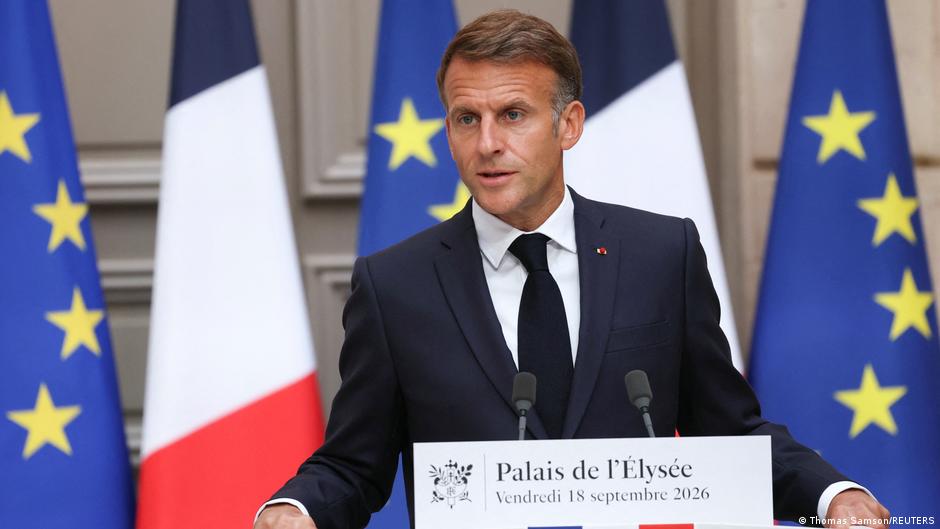
French President Emmanuel Macron said France views as credible a scenario in which Moscow could mobilize around 300,000 people, a warning that places Russia’s manpower decisions at the center of Europe’s security planning and corporate risk calculations.
Speaking Thursday, September 24, on TF1 and France 2, Macron said Russian authorities had waited for their elections to pass before moving toward what he described as an increasingly likely step. The elections to the State Duma were held from September 18 to 20, he noted.
“They waited for their elections, the elections have passed, and today it is clear that Russia will do this,” Macron said.
The French leader added that it remains unclear whether any mobilization would be publicly announced or carried out in a concealed way. He said there had been “several signs” indicating that Russia was preparing such a move, and described the assessment as consistent with intelligence from the United States, Europe and Ukraine.
“This is a scenario that seems credible to us,” Macron said.
Strategic Signal for Governments and Companies
For European governments, Macron’s remarks amount to more than a military forecast. They point to a broader strategic concern: that Moscow may be preparing for a longer phase of confrontation in which the boundary between battlefield escalation, covert pressure and attacks on civilian systems becomes increasingly blurred.
That has direct implications for boards, insurers, infrastructure operators and multinational companies with exposure to Europe. A Russian mobilization of roughly 300,000 people, if carried out, would be read not only as a military development but also as a signal about the Kremlin’s willingness to sustain the war and absorb additional domestic costs.
Macron also warned that “hostile actions across Europe have intensified” in recent weeks. He said he had convened representatives of political forces last week to brief them on the evolution of the threat and on its consequences for France.
“Russia believes that Europe is Ukraine’s strategic rear, because Europeans help Ukrainians,” Macron said. He also linked that view to Ukraine’s strikes on oil refineries and other sites inside Russia, which Kyiv has used as pressure intended to force Moscow to stop the war.
“And therefore Europe can become a target,” Macron said.
The French president said attacks are already taking place in the information sphere through the spread of falsehoods and in cyberspace. That warning reinforces a boardroom reality now familiar to European companies: geopolitical exposure is no longer limited to assets in or near a war zone. It can reach payment systems, logistics networks, energy infrastructure, communications platforms, suppliers and public trust.
Hybrid Threats Move Up the Agenda
Macron’s comments follow his statement on September 18 that France was preparing a plan to protect critical infrastructure amid a growing threat of hybrid attacks from Russia. The timing underscores how quickly the issue has moved from intelligence briefings into mainstream political and corporate governance.
European authorities have previously accused Russia of interfering in elections and using migrants as an instrument of pressure against Europe. More recently, European intelligence services have suspected a Russian trace in acts of sabotage, arson, attacks on critical infrastructure and airspace violations.
For companies, those categories map closely onto operational risk. Sabotage and arson threaten physical assets. Cyberattacks and hacking expose data, payment systems and industrial controls. Airspace disruptions affect transport, aviation, insurance costs and supply-chain reliability. Disinformation can complicate crisis response and damage public confidence in both institutions and corporations.
Macron said the scale of hostile activity may be larger than what is publicly visible. Sources cited in the source report said many incidents, particularly cyberattacks and intrusions, are not publicly disclosed. As a result, the actual scope of Russia’s hybrid attacks is significantly greater, according to those sources.
That lack of disclosure creates a difficult environment for executives and directors. Without a complete public picture, companies must make investment decisions on cyber resilience, physical security, redundancy and crisis communications while relying on partial signals from governments and intelligence services. Macron’s intervention suggests that Paris wants political leaders and the private sector to treat the threat as systemic rather than episodic.
The mobilization scenario also creates a planning problem for European policymakers. A public announcement from Moscow would be easier to interpret and communicate. A concealed mobilization would be harder to verify and could unfold gradually, complicating decisions about military support for Ukraine, sanctions enforcement, infrastructure protection and domestic preparedness.
Macron’s remarks indicate that France is preparing for both possibilities. His central message was that Russia’s view of Europe has changed: European support for Ukraine makes the continent part of the strategic environment Moscow is targeting. For corporate leaders, that means geopolitical risk is becoming a standing board agenda item, not a crisis file to be opened only after an attack.