Germany Sends Eurofighters to Latvia as NATO Air Defense Takes Center Stage
Berlin’s short-term deployment underscores how Baltic security demands are shaping NATO planning, defense commitments and allied risk management.
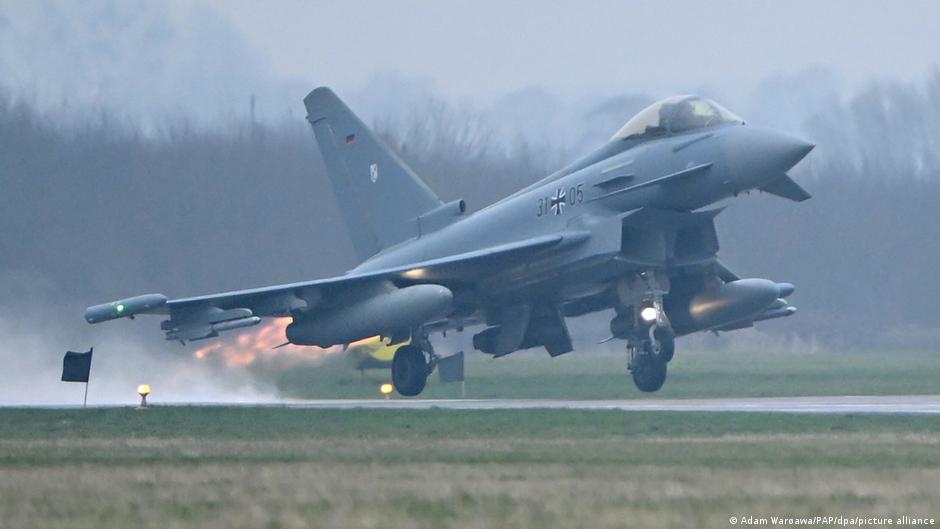
Germany has deployed four Eurofighter jets to Latvia for a short-term mission tied to the country’s parliamentary elections on October 3, a move that highlights how air defense on NATO’s northeastern flank has become both an operational priority and a strategic test of allied responsiveness.
The Bundeswehr transferred the aircraft from Tactical Air Wing 74, based at Neuburg an der Donau, to the Lielvarde military airfield in central Latvia. Latvia’s defense ministry in Riga announced the deployment on Thursday, September 24. The Eurofighters are expected to remain in Latvia for slightly more than a week, covering the election period while supporting NATO’s integrated air and missile defense system.
For NATO governments and defense planners, the decision is more than a temporary military movement. It reflects an alliance-wide management problem: how to allocate scarce, high-value air assets across a widening set of risks while reassuring exposed member states. Latvia, Estonia and Lithuania have depended on NATO air-policing arrangements since joining the alliance in 2004, but the full-scale Russian war against Ukraine has changed the operating environment. Repeated incursions by drones into Baltic airspace have raised the cost of delay and made visible allied support a central part of deterrence.
A short deployment with wider strategic implications
Riga requested support from NATO allies against the backdrop of repeated airspace violations in the Baltic states, the dpa news agency noted. The German deployment answers that request with a limited but symbolically significant package: four advanced fighter jets, crews and the political signal that Berlin is prepared to put military capacity into the region at a sensitive moment.
Latvian Prime Minister Andris Kulbergs thanked Germany on X for its “readiness to help and close cooperation.” He described the deployment as a concrete sign of NATO solidarity and of the allies’ joint commitment to protecting Latvian airspace and the security of Latvia’s population.
“This is a concrete sign of NATO solidarity and our joint commitment to protecting Latvian airspace and the security of Latvia’s population,” Kulbergs said.
For business readers, the episode is a reminder that executive decisions in the defense sector and government procurement are increasingly shaped by recurring operational needs rather than distant contingency planning. Air policing, air defense integration and rapid deployments are no longer abstract alliance functions. They are active, recurring requirements with budgetary, industrial and logistical consequences.
The Eurofighter, operated by several European air forces, sits at the center of those conversations. Deployments such as the one to Latvia place demands on maintenance systems, pilot availability, weapons readiness, base infrastructure and multinational coordination. Each mission may be short in duration, but the cumulative effect is to reinforce the importance of sustainment contracts, spare parts availability and long-term fleet planning.
Baltic airspace has become a boardroom issue
NATO has provided airspace protection on the alliance’s northeastern flank since Estonia, Latvia and Lithuania joined in 2004. That arrangement was built around the reality that the Baltic states did not field the same fighter capacity as larger NATO members. The alliance response has been to rotate aircraft and crews through regional bases, creating a shared security function that relies heavily on member-state commitments.
Since Russia launched its full-scale war against Ukraine, that structure has faced increased pressure. Drones have repeatedly entered the airspace of Baltic states. In August, NATO fighters shot down a drone that violated Latvian airspace. Such incidents have elevated air defense from a regional security concern into a core alliance-management issue.
For corporate boards and defense-industry executives, the implications are direct. Governments are likely to keep prioritizing readiness, interoperability and air-defense coverage, all of which influence procurement pipelines. Companies involved in aerospace platforms, radar systems, missile defense, maintenance, training and secure communications are operating in a market where political urgency can accelerate decisions, but where delivery capacity remains a constraint.
The deployment also illustrates the reputational dimension of defense commitments. Germany’s response was publicly welcomed by Latvia’s prime minister, reinforcing Berlin’s role as a key European security provider. In an alliance built on burden-sharing, such gestures are measured not only in military terms but also in diplomatic and political capital.
At the same time, the limited duration of the mission shows the practical limits of available capacity. The Eurofighters will be in Latvia for slightly more than a week, not as a permanent replacement for broader NATO air-policing structures. The task is targeted: support Latvia during parliamentary elections and contribute to NATO’s integrated air and missile defense posture.
Longer-term commitments are already on the calendar. From December 2026, Eurofighter jets are scheduled to again take on NATO airspace surveillance from Estonia as part of the NATO Air Policing mission. Until March 2027, five Eurofighters and their flight crews will be stationed at Amari Air Base in northwestern Estonia.
That planned deployment gives the current Latvian mission a broader context. NATO is not improvising one aircraft movement at a time; it is managing a rotating security architecture that depends on predictable commitments from major member states. For defense ministries, that means balancing near-term incidents with scheduled missions. For industry, it points to continued demand for aircraft readiness, support services and integrated air-defense capabilities.
The decision to send German Eurofighters to Latvia during an election period therefore carries meaning beyond the immediate security operation. It shows how democratic resilience, military readiness and alliance credibility are increasingly intertwined. For NATO’s northeastern flank, the message is reassurance. For Berlin, it is an assertion of responsibility. For the defense business, it is another signal that airspace security in Europe has moved from episodic crisis response to sustained strategic demand.