Russian Strikes on Kyiv Extend Risk Calculus for Ukraine’s Institutions
The overnight attack followed daytime strikes that killed two people and hit key academic and medical facilities in central Kyiv.
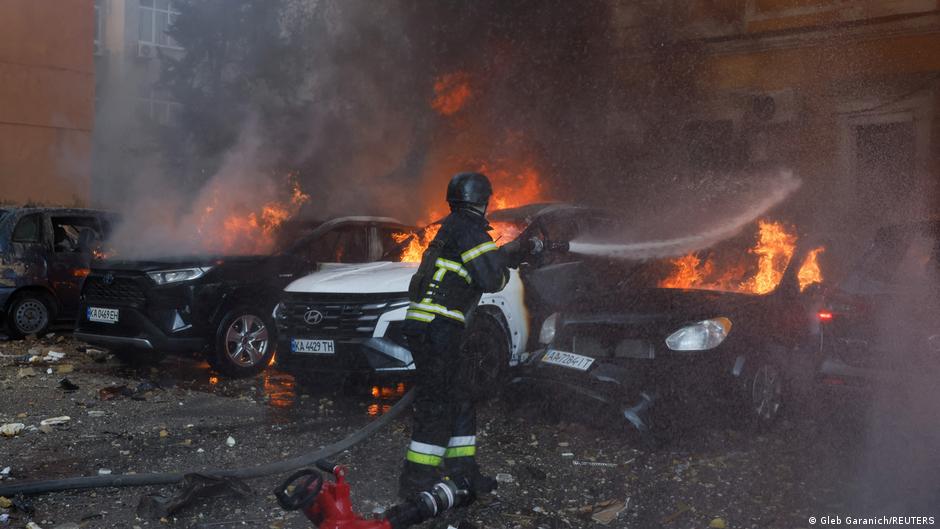
Russia continued its assault on Kyiv overnight into Tuesday, September 29, extending a sequence of strikes that has targeted the Ukrainian capital across both business hours and nighttime civilian routines. For Ukraine’s public institutions, employers, health providers and municipal leadership, the attacks underscored a persistent operational reality: core urban functions remain exposed to sudden disruption even far from the front line.
According to Ukrainian officials, Russian forces again attacked Kyiv after earlier daytime strikes in the city center, including a hit on the building of Ukraine’s National Academy of Sciences. Mayor Vitali Klitschko said debris from a ballistic missile fell in the courtyard of a residential building. No information had been reported about deaths or injuries from the overnight strikes.
“In the Solomianskyi district, missile debris fell in the courtyard of a residential building. There is no fire. In the Pecherskyi district, there is a fire in a three-story nonresidential building,” Klitschko wrote on Telegram.
Klitschko later clarified that in the Solomianskyi district, a fire broke out in one of the buildings of an educational institution after the strike. The Kyiv City Military Administration also reported that a drone had fallen on a roadway. Officials additionally said a fire occurred after debris landed on the roof of a five-story building in the Holosiivskyi district.
Institutional Targets and Urban Resilience
The latest overnight strikes followed daytime attacks in central Kyiv on September 28, when two people were killed and 26 others were wounded, according to Klitschko. Eight of the injured required hospitalization, and one was in serious condition, he said. Those figures frame the attack not only as a security event, but as a management challenge for city authorities and essential-service operators forced to coordinate emergency response, health care capacity, transport disruption and building safety assessments under continuing threat.
Both fatalities were caused by a drone strike on the building of the National Academy of Sciences of Ukraine. The attack triggered a major fire, leaving people trapped inside and forcing many to escape through windows. For an institution central to Ukraine’s research and scientific establishment, the damage carries broader implications than the immediate structural harm. Academic and research organizations depend on continuity of personnel, records, laboratories, archives and administrative systems; strikes on such facilities can impair long-term institutional capacity even when the casualty count is limited.
Another Russian strike hit the building of Dobrobut, a medical center. The impact on a health care facility adds to the operational burden facing Kyiv’s medical system, which must treat casualties while maintaining routine care and preparing for further emergencies. For executives managing hospitals, clinics, universities, research bodies and companies in the capital, the pattern of attacks reinforces the need for contingency planning that extends beyond cyber resilience and supply chains to physical evacuation routes, redundant sites and staff safety protocols.
The overnight reports described a dispersed pattern of impact points: missile debris in a residential courtyard, a drone on a roadway, debris on the roof of an apartment building, a fire in a nonresidential structure and a fire at an educational facility. That distribution illustrates the uncertainty confronting municipal officials and private-sector operators alike. Even when a strike is aimed at one type of target, debris and secondary fires can spread the consequences across residential, educational, transport and commercial zones.
Boardroom Implications of a Capital Under Fire
For American business readers, the Kyiv attacks point to the corporate governance problem embedded in Ukraine’s wartime economy. Boards and senior executives with exposure to Ukraine, whether through employees, contractors, logistics networks, research partnerships or humanitarian operations, face a risk environment in which civilian infrastructure and institutional buildings can be hit with little warning. The question is not simply whether a company can keep operating, but how leadership accounts for duty of care, insurance, facility redundancy and crisis communications under repeated attack.
Kyiv remains Ukraine’s political and administrative center, but it is also a hub for technology firms, universities, medical providers, media organizations and international operations. Strikes on a scientific institution and a medical center therefore carry symbolic and practical weight. They affect the confidence of workers and families, raise costs for security and business continuity, and complicate decisions about in-person work, international travel and capital allocation.
The absence of reported deaths or injuries from the overnight wave does not reduce the significance of the broader sequence. From the start of September 28 through the subsequent overnight attack, Kyiv authorities were managing fatalities, dozens of wounded residents, fires, damaged buildings and reports of missile and drone debris across several districts. In corporate terms, this is a stress test of urban systems and executive preparedness under conditions where the next incident may arrive before recovery from the previous one is complete.
The attacks also sharpen the policy backdrop for companies and investors assessing Ukraine-related risk. Russian strikes on the capital continue to affect not only military calculations but civilian institutions that support economic life: research, health care, education, transport and housing. For boards, the immediate lesson is operational. Exposure to Ukraine requires plans that assume overlapping disruptions, real-time employee accountability and coordination with local authorities. For policymakers and donors, the events highlight the continuing need to protect and restore the institutional infrastructure that allows the country’s economy and public services to function during war.