Ukraine Sanctions Organizers of Russian Duma Voting in Occupied Regions
President Volodymyr Zelensky targeted 44 people accused of helping stage Russian parliamentary voting on occupied Ukrainian territory.
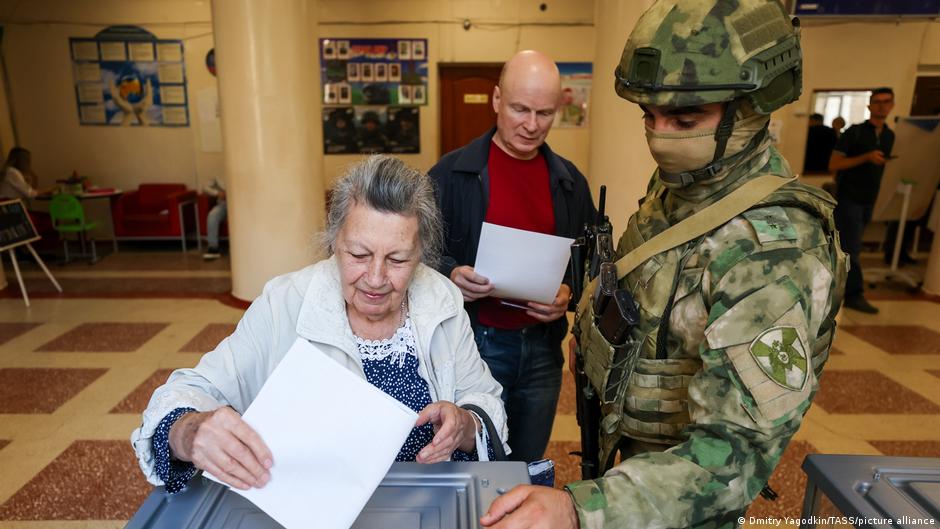
Ukraine has imposed sanctions on individuals accused of helping Russia organize State Duma elections in territories occupied by Russian forces, a move that sharpens Kyiv’s effort to raise the personal and institutional cost of Moscow’s political integration campaign.
President Volodymyr Zelensky introduced the measures on Saturday, September 27, targeting 44 people connected to the organization of the Russian parliamentary vote in occupied areas of Ukraine. According to the Office of the President of Ukraine, 38 of those sanctioned hold both Ukrainian and Russian citizenship.
The decision comes after the European Union said it was prepared to add people involved in facilitating the voting process in occupied Ukrainian territories to its own sanctions lists. For Kyiv, the sanctions serve both as a legal instrument and as a political signal: participation in Russian-administered electoral structures in occupied regions is being treated as collaboration with an unlawful process, not as routine local governance.
Sanctions as a corporate-style accountability tool
While the issue is rooted in war and territorial occupation, the decision also reflects a broader management logic increasingly visible in Ukraine’s sanctions policy. Kyiv is targeting not only senior political figures but also the operational layer that makes Russia’s administrative strategy viable: local officials, party operatives, and public-facing candidates who give institutional form to Moscow’s claims over occupied territory.
The Office of the President said some of the sanctioned individuals had already been “elected” as so-called deputies of illegally created local councils on temporarily occupied Ukrainian territory. That detail matters because it suggests Ukraine is tracking career pathways inside the occupation administration, identifying people who have moved from local proxy structures into Russian federal political mechanisms.
Ukraine and its Western allies have recognized both the voting process and its results as illegal.
Russia held its State Duma elections from September 18 to 20. For the first time in parliamentary elections, Russian authorities organized voting in occupied parts of Ukraine’s Kherson, Zaporizhzhia, Donetsk, and Luhansk regions. Ukraine and Western countries allied with Kyiv rejected the process and its outcomes as illegal.
The sanctions list therefore targets a specific layer of risk around the elections: not merely the fact that Moscow conducted voting, but the people who helped normalize, administer, or benefit from that vote. In boardroom terms, Kyiv is attempting to change the incentive structure for anyone considering a role in occupation-linked institutions.
Russia’s electoral architecture in occupied regions
For the 2026 State Duma elections, Russian authorities for the first time created separate single-member districts for Ukrainian regions occupied after 2022. That step marked a new phase in Moscow’s political strategy: occupied territories were not only folded into symbolic narratives but also assigned formal electoral channels into Russia’s lower house of parliament.
Following the vote, Russia announced winners in single-member districts across the occupied territories. In the so-called Donetsk People’s Republic, the declared winners were Irina Kuksenkova, a war correspondent for Russia’s Channel One, and Alexander Borodai, the former “head” of the self-proclaimed republic. In the so-called Luhansk People’s Republic, Russia named local “parliament deputies” Denis Kolesnikov and Ivan Sanayev as elected.
In occupied parts of Zaporizhzhia region, Russia announced Alexei Tikhomirov as the winner. In occupied Kherson region, the declared winner was Elena Dmitruk, described as a deputy chair of the local parliament. All of these candidates were nominated by United Russia, the ruling party that has served as the central political vehicle for the Kremlin’s domestic and occupied-territory agenda.
The use of United Russia candidates underscores the strategic character of the process. Rather than leaving the occupied regions to marginal proxy parties or purely local figures, Moscow placed them within the ruling party’s federal electoral machinery. That carries implications for how Russia presents governance, resource allocation, and political loyalty in territories it controls militarily.
In addition to single-member district winners, eight more representatives of the “authorities” in Ukraine’s occupied territories entered the Russian State Duma through federal party lists. Among them was Serhiy Arbuzov, the former first deputy prime minister of Ukraine under President Viktor Yanukovych and former head of the National Bank of Ukraine. Arbuzov was nominated by the A Just Russia party.
His inclusion is notable because it connects the current occupation-linked political structure to older networks from Ukraine’s pre-2014 political order. For Ukraine, such figures represent not only participation in Russian institutions but also the repurposing of former Ukrainian state experience in support of Moscow’s political project.
Implications for Moscow’s local partners
The immediate legal impact of Ukraine’s sanctions falls on the 44 named individuals, but the broader purpose is deterrence. By formally penalizing those who participate in election organization or occupation-linked political structures, Kyiv is sending a message to local elites, administrators, and candidates that cooperation with Russian electoral processes can carry lasting consequences.
The expected European Union response could amplify that pressure. If Brussels follows through with sanctions against people who helped stage the elections, affected individuals could face restrictions beyond Ukraine’s jurisdiction, including limits connected to travel, assets, and dealings with European institutions or counterparties.
For Russia, the vote was designed to show institutional consolidation in occupied territories. For Ukraine and its partners, the sanctions response is meant to deny that consolidation any legitimacy and to make the individuals involved accountable. The result is a contest not only over territory but over the administrative and political personnel willing to serve Moscow’s long-term strategy.