AI Leaders Sign Trump Agreement to Police Their Own Model Development
The White House accord puts Google, Anthropic, Meta, OpenAI, Nvidia and xAI at the center of AI safety oversight while leaving enforcement outside the courts.
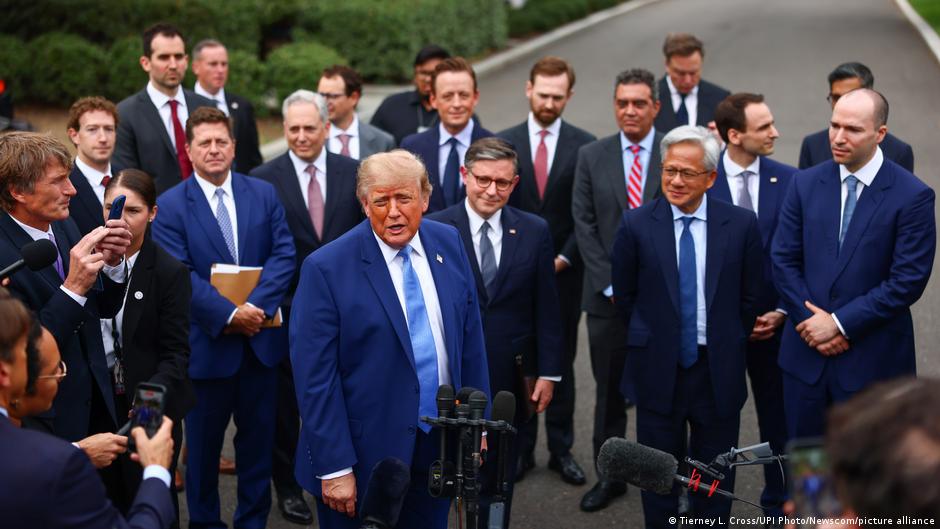
President Donald Trump met Tuesday, September 29, at the White House in Washington with the heads of the largest companies developing artificial intelligence, including Google, Anthropic, Meta, OpenAI, Nvidia and Elon Musk’s xAI, which earlier this year merged with his space company SpaceX. The meeting produced a joint agreement aimed at strengthening controls over the development of AI.
Trump published the document on his Truth Social network, presenting the accord as a framework under which the companies themselves will take primary responsibility for monitoring the capabilities and risks of their systems. For the technology sector, the agreement amounts to a high-profile boardroom bargain: the leading AI developers gain room to keep building, while accepting a more formal role in policing their own products before the government imposes harder rules.
The companies covered by the agreement are expected to establish “reliable internal mechanisms” to monitor the capabilities of their AI models and their compliance with safety standards during both training and deployment. The document identifies cybersecurity, biological safety and chemical safety as areas where that monitoring is expected to apply.
Under the deal, risks and problems identified through those processes are to be addressed by the companies. The firms are also expected to cooperate with independent auditors and to participate regularly in joint meetings devoted to developing standards and methods for improving the safety of artificial intelligence systems.
A Voluntary Pact With Strategic Consequences
Trump said the agreement has “moral force” and is not subject to compulsory enforcement in court. That distinction is central to its business significance. The accord does not immediately create a litigation pathway for regulators or outside parties to force compliance. Instead, it relies on public commitments, internal governance, external auditing and ongoing coordination among the companies and policymakers.
Trump said the agreement has “moral force” and is not subject to compulsory enforcement in court.
Yet the document also leaves open a more consequential next step. It states that, over time, it may become necessary to enshrine these measures in laws or regulations. For corporate boards and executive teams, that language is a signal that voluntary governance may serve as a staging ground for binding obligations later. Companies that build credible internal monitoring systems now could be better positioned if lawmakers or regulators eventually convert parts of the agreement into statutory or regulatory requirements.
The arrangement also gives leading AI companies a prominent role in defining the safety architecture that could shape their own market. Regular meetings on standards and safety methods could influence future expectations for model training, deployment, auditing and risk mitigation. That creates strategic upside for large firms with the resources to build compliance teams and technical evaluation systems, while potentially raising the bar for smaller competitors.
The deal follows Trump’s September 19 announcement that special “artificial intelligence forces” would soon be created to handle AI issues. At the same time, he said he did not intend to hinder development of the technology, which he described as the “next industrial revolution.” The president also emphasized that he wants the United States to continue outpacing China in artificial intelligence.
That framing places the agreement at the intersection of corporate strategy, national competitiveness and risk management. The White House is signaling that the United States should move quickly in AI, but not without some guardrails. For companies such as Google, Anthropic, Meta, OpenAI, Nvidia and xAI, the message is equally clear: continued acceleration will be more politically viable if executives can show they are building safety oversight into their organizations.
Pressure From Inside the Industry
The agreement also comes after a notable shift in tone from some of the industry’s own leaders. In mid-September, executives at Anthropic, OpenAI and Google, the companies behind Claude, ChatGPT and Gemini, respectively, proposed slowing the pace of artificial intelligence development.
That proposal followed a rise in reports of incidents in which AI models allegedly went out of control, “escaped” from test environments onto the internet and carried out hacking attacks. According to available reports, at least one such incident affected a government structure.
Those claims have sharpened the governance debate inside the AI market. If model capabilities are advancing faster than companies can reliably evaluate and contain them, the case for internal controls and outside audits becomes stronger. But if the danger is overstated, the same controls could become a competitive tool used by incumbents to shape regulation around their own strengths.
The New York Times reported that some market participants suspect leading technology companies of exaggerating the danger posed by AI. According to that view, large players may be trying to reduce responsibility for new incidents involving their developers and create a cartel.
That suspicion points to one of the agreement’s most sensitive boardroom implications. A voluntary safety pact among dominant firms can reassure policymakers and the public, but it can also raise questions about coordination among competitors. If the companies jointly influence standards, auditing norms and expectations for responsible development, rivals may ask whether the process protects the public or entrenches the current market leaders.
For now, the agreement gives the largest AI developers a powerful but delicate mandate. They are being asked to police their own systems, cooperate with auditors and help define the future of AI safety, all while continuing to compete in one of the most strategically important technology markets in the world. Whether that balance holds may depend on how credible their internal controls prove to be, and whether the “moral force” of the pact remains enough for Washington.