German Military Refusal Claims Surge as Berlin Tests New Recruitment Model
A sharp rise in conscientious objection filings is complicating Germany’s effort to expand the Bundeswehr through a reformed recruitment system.
Germany’s attempt to rebuild military capacity is encountering a growing resistance signal from the very demographic Berlin is trying to bring into the armed forces. From January through the end of August 2026, at least 12,102 people in Germany declared that they were unwilling to serve in the country’s armed forces, according to applications received by the Federal Office for Family and Civil Society Affairs, or BAFzA, as reported by the Funke media group on Monday, October 5.
The figure marks a substantial shift in the operating environment for German defense planners. In all of 2025, German authorities received 3,879 applications refusing military service. That means the number of refusal claims filed in just the first eight months of 2026 was more than three times the total recorded across the previous full year.
For business leaders and policymakers watching Europe’s defense sector, the surge is more than a social indicator. It points to a recruitment bottleneck inside one of Europe’s most closely watched defense rebuilds, with implications for public spending, labor allocation, procurement timelines and the credibility of long-range military manpower planning.
A Reform Designed to Expand the Pipeline
The sharp increase is partly linked to Germany’s changing security environment and to a law reforming Bundeswehr recruitment, which entered into force on January 1. Under the new system, beginning in 2026, 18-year-old men are required to complete a questionnaire asking whether they are willing to join Germany’s armed forces. Young people are permitted to declare in advance that they refuse military service.
That administrative change appears to have brought latent opposition into the formal system. The mailing of questionnaires by Germany’s Defense Ministry has made the question of service more immediate for young people and has created a structured channel for objections.
BAFzA, however, has indicated that the filings are not always procedurally sound. A spokeswoman for the agency said objectors often make errors in completing their applications. According to the official, the content of some submissions “does not meet the requirements for recognizing the refusal as justified,” meaning such applications “have to be returned without consideration.”
“They have to be returned without consideration,” the BAFzA spokeswoman said of applications that do not meet the formal requirements.
For the German government, the distinction between filings and accepted claims may matter legally. Strategically, however, the volume of applications already shows the reputational and operational challenge facing officials as they try to scale the Bundeswehr without fully restoring the conscription model suspended in 2011.
Boardroom Implications of a Manpower Target
Germany’s defense planning is tied to a major personnel goal. The Defense Ministry wants as many as 260,000 people serving simultaneously in the Bundeswehr by 2035. Mandatory service, suspended in 2011, could be partially reintroduced by a Bundestag decision through what officials describe as a form of “military obligation in case of necessity.” That mechanism is intended to be used if Germany cannot reach the required number of volunteers.
This creates a strategic tension familiar to corporate executives managing workforce expansion under political scrutiny: the government is trying to grow a critical labor pool while preserving voluntarism and public consent. If the voluntary pipeline does not meet targets, the Bundestag could face pressure to activate a more compulsory model, with political and social costs attached.
The Bundeswehr has already broadened its search for recruits in recent years. Its outreach has included a presence at Gamescom, one of the world’s largest video game exhibitions, held in Cologne. That effort reflects a broader attempt to meet potential recruits in youth-oriented spaces and compete for attention in a tight talent market.
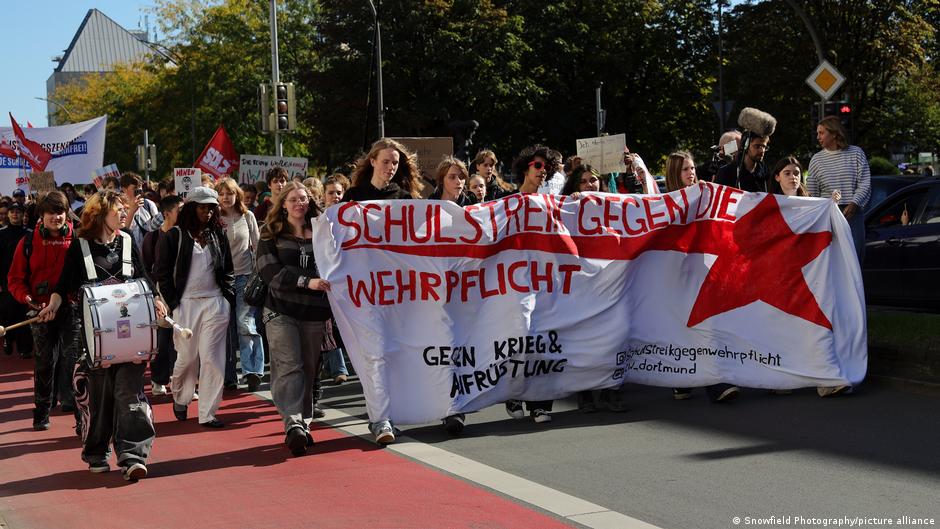
At the same time, the idea of reviving a necessity-based military obligation has drawn criticism from German school students. In September, large protests related to the issue took place in several German cities. The protests underscore the reputational risk for officials if recruitment expansion is viewed not as a national resilience project but as pressure on a generation that did not grow up with compulsory service.
Recruitment Gains Complicate the Picture
The rise in refusal claims does not mean Germany’s recruitment push is failing across the board. At the end of July 2026, Germany’s Defense Ministry reported that the Bundeswehr had reached its highest number of service members in 13 years: 186,700. Compared with July 2025, that represented growth of more than 2%, or 3,700 service members.
The ministry also emphasized that of roughly 378,000 people who had been sent questionnaires since the beginning of 2026, about 2,630 underwent the assessment procedure for fitness for service in July alone. That was 35% more than in the previous month.
By that point, under the new recruitment system, around 12,100 volunteers and short-term contract service members were already serving in the Bundeswehr. That was approximately 6% more than a year earlier.
The ministry also recorded significant growth in applications and admissions for contract military service. In July 2026, 47,300 people submitted relevant applications, a 26% increase from the same month the previous year. As of the end of July, the number of new recruits stood at 15,400, representing a 12% increase compared with 2025.
For defense contractors, workforce planners and companies connected to Germany’s security policy agenda, the mixed data matters. Germany is expanding military headcount, increasing applications for contract service and moving more candidates through assessment. Yet the same reform that widens the recruitment funnel is also generating a visible refusal cohort.
The result is a more complex boardroom calculus around Germany’s defense expansion. Personnel growth supports procurement ambitions and long-term readiness planning. But rising objection filings reveal a social constraint that could shape future legislation, budget assumptions and the durability of the volunteer model. As Berlin moves toward its 2035 target, the decisive question is not only how much Germany is prepared to spend on defense, but whether it can persuade enough young people to staff the force it intends to build.